Categories
Blog

#MVP | First and Third – Stealing – Throw the Ball!

In a first and third scenario where the other team is stealing this is especially true. Particularly when the sole purpose of the offense is to distract the defense, with the intent they will focus on the runner stealing versus the runner scoring.

In general trick plays seem to decrease as you get older, but I must admit I have seen them ran successfully in college and even in the major leagues. Which means it really is hard to keep your composure, suppress your emotions, and continue to play the game mentally.

I am sure there are others, but here are the ones I have seen coaches use the most.

Force Balk – As the pitcher starts his wind-up the runner at first takes off. Hoping the pitcher will emotionally panic and balk.

Variation against the Left Handed Pitcher: Since he is facing the runner at first, the runner takes off for second after the runner at third heads for home.

The Aw [explicative] Play – Knowing the batter is taking all the way, the runner at first takes off only to fake a fall midway. To create the maximum attention on the fact he fell [surely an easy out] he yells loudly as he falls. The runner takes off when the catcher releases the ball to second.

Picked Off On Purpose – Enticing the pitcher to pick-him off the runner at first takes a longer than normal lead with the intent to get into a run down until the runner from third scores.

Making it very difficult to keep your composure, these trick plays are usually performed late in a close game, when there are Two Outs and in many cases when there are Two Strikes on the batter!

Instead of focusing on the batter and preventing the runner on third from scoring we emotionally fall for the bait. We visually suppress all our knowledge and the mental side of baseball for whatever number of seconds we emotionally believe the other team is giving us the third-out. Reality, their intent is to score a run.

Knowledge and understanding the purpose behind the trick plays before hand is critical, but talking when a first/third situation arises in a game is the key to prevention. In fact being vocal throughout the infield not only strengthens each player’s mental focus, but it may make the opposing coach second-guess whether to try one or not.

After all, they only work if the defense emotionally makes the wrong decision.

Keeping your mental composure – Defensive Considerations 

Pitcher

  • Pitch the ball. A pitcher should make the decision to throw over or pitch before he goes into the stretch. Late in the game the batter, the runner at third and the out is more than the runner at first
  • Step-off and focus on the runner at third. If you want fake the throw to first, and see if the runner at third makes a mistake
  • Worse that can happen you still have two outs with a runner at second and third

Catcher

Runner steals.

  • Third steps to the infield side of the bag shakes his glove if the runner at third is too far off the bag. Catcher sees it in his peripheral vision and throws to third
  • Throws to second. SS covers the bag with the 2B in line with the throw watching the runner at third
    • If he goes, 2B cuts the throw off and throws home and follows his throw in the event there is a run-down
    • If he stays close to third, he lets the throw go through and the SS makes the tag coming up ready to throw home
      • If the runner stops and attempts to get into a run-down the SS focuses on the runner at third and walks towards the runner back towards first base
      • If the runner from third breaks towards home he throws to the catcher to get the out

Whether you are a purist of the game, or maybe which side of the trick play you are on, it is a thing of beauty when the defense keeps their composure and gets the runner out going from third to home. The icing on the cake is the bang-bang double play runner getting the runner stealing second and runner going home.

Until next blog,

Head-Shot-for-Newsletter-Smaller

Al McCormick

Categories
Blog

#MVP | Have We Forgot the Definition of Pitching?

Too often we overcomplicate what it takes to play the game of baseball and thereby loosing sight of the games real objective. Nowhere is this more prevalent than when we teach pitching.

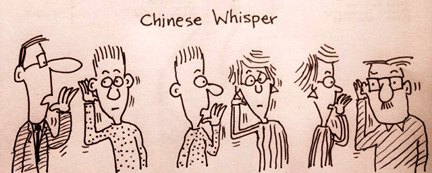
By definition, pitching is the act of “delivering or serving the ball to the batter.” As with most techniques in baseball the facts are lost with coaches playing the Chinese Whisper game [one whispers a message to another, and as errors accumulate due to erroneous corrections, the message is completely changed by the end of the line].

CW

Coaches today seem to be preaching a pitcher needs a curveball or slider to be successful which I argue is modifying the initial whisper, “A fastball with movement is the toughest pitch to hit in baseball.”

What is worse, the coaches that do value the importance of the fastball have replaced movement and hitting their spots with radar guns and velocity. Succumbing to the Chinese whisper fallacies and replacing mechanics and efficiencies with some arbitrary velocity.

To win a pitcher has to throw in the 90’s to win. In today’s world in the high 90’s.

Jered Weaver, California Angels, won 18 games averaging 86 mph in 2015 was quoted as saying, “It’s more about getting location down…

JW

Yet, ask a coach, a college recruiter, or a professional scout to describe what they are looking for in a pitcher; a pitcher who throws hard. I thought it was about winning?

DIBaseball.com described Andrew Beckwith, after throwing the fewest pitches thrown in 9 innings a College World Series game since 1981, “he did not issue any walks, and he induced 15 groundball outs, pitching to contact early in counts and letting his defense work…”

AB

Instead of worrying about velocity Beckwith [does not throw 90], the 2016 Gregg Olson Award for Breakout Player of the Year, describes himself as, “… a contact pitcher, and I really do trust my defense.

The same is true about one of the best, Greg Maddux.

GM

Greg Maddux against the Cubs threw 63 strikes and threw a 9 inning complete game, tossing only 76 pitches.

Inning       Pitches

First:          7

Second:     11

Third:         9

Fourth:       11

Fifth:          7

Sixth:          7

Seventh:    7

Eighth:       9

Ninth:         8

Total:         76

A game Maddux defines as: “I got some first-pitch outs and they didn’t hit a lot of foul balls.

As a Coach or as a Player Tell Yourself:

  • If Andrew Beckwith can trust his defense to pitch a 98 pitch complete game to a 2-1 win against Number #1 Florida
  • If Jered Weaver can win 18 games for the California Angels in 2015 throwing 86
  • If Greg Maddux can toss a 76 pitch complete game against the Chicago Cubs throwing and hitting his spots with a fastball that moves

Then developing a fastball that moves should be my focus and realizing success at the highest level will come when I am able to do so and hit my spots.

Until next blog develop your fastball and hit your spots,

Head-Shot-for-Newsletter-Smaller

Al McCormick

Categories
Blog

#MVP | We Convince Ourselves, But No Way That’s True

According to William of Ockham (1285-1349) Law of Parsimony (Ockham’s Razor) simply states, select the answer with the fewest assumptions.

Really1

Just because Bill Buckner let the ball go between the wickets in Game 6 of the 1986 World Series, and in 2016 the San Diego Padres blew a 12-2 lead over the Seattle Mariners does not mean coming from behind is the norm.

Or is it?

JoeF

“Just the facts, ma’am.”

FACTS: SportsLibrary.net states comeback wins hardly ever happen. They stated the team who scores the first run of the game usually wins approximately 70% of the time. It’s still not 100%, so according to the Law of … who cares, as a coach I have found the answer to the majority of my questions surrounding the game of baseball were found AFTER we played the game, not before.

The ninth inning is the toughest outs in baseball,” and the “last out is the toughest one to get.”

Not sure we need a law for this one, but with a team getting the same number of outs in the first as in the last inning  and the game only allowing three strikes to each batter, then the least number of assumptions has to be, “the results are determined by how we play each game at this moment.

I know, duh!

Sharon Gannon said it best, “We create the world we live in.”

Until next blog, “Just the fact, ma’am.”

Head-Shot-for-Newsletter-Smaller

Al McCormick

Categories
Blog

#MVP | Luck does not exist! You just can’t Win for Losing

 LUCK?

My issue is not about taking chances, it’s how we rationalize the results of the chances we take. Especially when I know luck is defined as, “success or failure apparently brought by chance rather than through one’s own actions.” This is why I agree with British author Joe Abercrombie who said,

There was no such thing as luck. Luck was a word idiots used to explain the consequences of their own rashness, and selfishness, and stupidity.”

Not calling anyone an idiot, but I do agree and believe Luck is not real. Not even in baseball.

We just use the word luck so we doe not have to take ownership of our performance, Good or Bad. In each case we avoid demanding improvement when it comes to dealing with our athletic ability. It is much simpler to define our successes and our failures in a form of Luck, versus spending time Understanding why we succeeded or why we failed. Either way we prevent improvement by:

  • Failing to mentally recognize when we have done something right or
  • Failing to identify what we need to improve on

Instead we waste time defining why certain results occur, as Katie Whittle stated in her article “When Good Things Happen to Other People: How to Be Luckier,” She stated;

When favorable events repeatedly occur against the odds, we attribute it to good luck;

 [Likewise], when things take a turn for the worst and misfortune seems to strike us when we are least able to handle it, we curse our bad luck.

Focus on what it takes to be a good baseball player and quit wasting your time trying to define your day-to-day results, Good or Bad. Certainly don’t define the effects of your At-Bats, Fielding, or Pitching as Luck. Use the results as knowledge and an opportunity to improve!

When you have a hiccup, recognize what you are doing wrong, identify what you need to do to correct it, and then CHANGE. One thing is certain, “If you change nothing, nothing will change.”

When you do something right, reinforce success. Tell yourself, “That’s what I am looking to do,” then demand it in the future.

After all, luck is nothing more than being ready when the opportunity presents itself.

Contact Most Valuable Player if you Need Help with any aspect of your game.

Until next blog remember success breeds success,

Head Shot for Newsletter Smaller

Al McCormick

Categories
Blog

#MVP | Solve the Problem, Not the Effects of The Problem

I remember an article by Celes, “How to Create Real Change in Life…” where she asked, “If you remove the weed using a mower, does that solve the problem?

NO! Yet true resolutions can only be understood once you confront, and actually see the problem. Because we never removed the root thereby never solving the real problem,  the weed came back!

In many cases once you know the problem you can identify multiple ways to solve it. Example. Solve the sum of three numbers [e.g., 14 + 7 + 54].

When asked, most spend very little time debating over where the number 14 came from or wonder why the number 54 was placed at the end and why the number 7 was stuck in the middle. They just focused on what they were being asked to do; add three numbers together. Nothing more, nothing less.

Some will solve the problem by adding the first two numbers together, then adding that total to the last number while others will total the ones column, carrying the 1 and total the tens column.

Both get 75 as the answer.

We solved the problem without wasting time discussing whether any of the numbers are prime, what the numbers being used for, or wasting time debating the best way to solve the problem. We just solved it with out dealing with the effects the problem may or may not create. We don’t care!

Let’s solve a major problem in todays world described as prejudice, discrimination, or antagonism. A problem we created by classifying human beings in such a manner some people actually believe they are superior over another.

Resolution to this problem is so simple; we just need to make it happen. Eliminate classifications and recognize everyone as human beings.

Morgan Freeman’s who said in a 60 minutes interview: “I’m gonna stop calling you a white man and I am going to ask you to stop calling me a black man. I know you as Mike Wallace and you know me as Morgan Freeman.”

Until we approach human beings in this manner we fit Albert Einstein’s definition of insanity, “Doing the same thing over and over again and expecting different results?”


Until next blog,

Head-Shot-for-Newsletter-Smaller

Al McCormick

Categories
Blog

#MVP | Independence – Talk or Action

As parents we seek independence for our sons at an early age. However, philosophically the definition of independence we choose for our sons is more talk than action. In almost a bragging fashion, we talk about how important it was for our son to go away to college, experience life, and do so in preparation for the demands of adulthood.

Oh we start out with good intentions helping him decipher what it takes to avoid life-altering mistakes and make a good decision, but our helpful words are usually followed with a threat, “you need to recognize every decision you make will be on you, and one screw up could affect you the rest of your life.”

Reality?

As well-intentioned, misguided parents our actions speak louder than our words. We never let our sons decide which team to play for, or even think about what college he should consider and why. Unfortunately, even as well educated parents, we tend to make uniformed decisions when it comes to baseball.

Decisions clouded by ego and what others think. No wonder when it comes to picking a college too many players end up at the wrong school. The beginning of what Jim Taylor, PH.D, identifies as “reversing our direction and stymie our son’s progression towards adulthood.

Recipe for Success: Decide which college is best for your son is based upon the answer to three simple questions your son needs to ask himself;

Do I like the Coach?
Does the Coach like me?
Will I get a chance to play there?

Contact Most Valuable Player if you Need Help finding College Choices.

Until next Blog,

Head-Shot-for-Newsletter-Smaller

Al McCormick

Categories
Blog

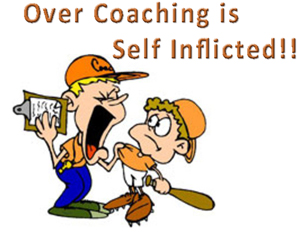
#MVP | Over Coaching is Self Inflicted

I know a team who consistently makes it to the World Series, but never seem to win the big game. What may surprise you is one player’s response answer when I asked him, why?

According to him, mistakes were not learning experiences, they were consequences resulting in berating comments, running, yelling, then more running. In fact he said, “Losing meant we sucked and practices the next couple of days were unbearable!

When a parent confronted the Coach as to why the overabundance of what he termed Tough love, he stated, “this is what it takes to get the most out of his Team!” Usually followed by him blurting out how many World Series they participated in.

Unfortunately, the starting player viewed it from a different perspective “They were just afraid to lose.

As a dad, as a coach, and as a mentor, what he said next made me really sad;

“Making it to the World Series was a sigh of relief; the season was almost over, and finally the screaming and hollering no longer affected them. It went in one ear and out the other.”  Unfortunately so did their World Series experience, usually resulting in a two-and-out trip most of the time.

Kind of makes you shake your head?

admitting-Mom

Before we start looking for a place to lay blame, ask yourself, ever pick a team because they have better-looking uniforms, play in more tournaments, they seem win more, and for some, as a badge of honor we equate better with costing more?

  • Baseball is simpler than that!
  • Baseball is about being Good!
  • Baseball is an Individual Sport in a Team Concept

So here’s my recommendation to eliminate Over Coaching:

Recognize a player does not get better by playing better competition and being around better players. A player get better when they realize improving is about KNOWLEDGE and UNDERSTANDING and their ability to learn to apply what they have learned.

So the only team to play for is one that provides them the ability to try things, make mistakes, and learn. A team conducive to truly getting better.

Then and only then will you learn to become YOUR OWN COACH!

  • Believe in yourself
  • Take a chances, and learn from the results
  • Focus on facts versus Ego
  • Understand Humility is part of Learning

Until next Blog seek baseball knowledge and understanding – MOST OF ALL Become your OWN COACH!

Head-Shot-for-Newsletter-Smaller

Al McCormick

Categories
Blog

#MVP | Are You Selling Yourself Short?

If they can make penicillin out of moldy bread, they can sure make something out of you.” ~ Muhammad Ali


MA


I do believe struggle and criticism is a pre-requisite for greatness. I also know it is not fun finding out your weaknesses, but as a mentor of mine told me, “The key to his success was knowing what he didn’t know, and getting it.”

Know what you don’t know is the strategic difference between those who make it in the game of baseball and those who do not.

  • Those that make it – Want to know why they are struggling
  • When they know – The great ones use the knowledge to improve

Unfortunately baseball is a game filled with fallacies [e.g., you have to take a pitch on the outer half of the plate the other way] and statements that make you shake your head [e.g., Will you please throw strikes].

If you want to play this game a long time, then know what you don’t know, but make sure what you are being told offers value. UNDERSTAND what is being said, and WHY is it making you better.

On the other hand, it is easier to be contented with who you are in the moment [e.g., after all you’re on varsity], rather than push yourself to be something else – GREAT. However I want you to know justifying it always falls on deaf ears [e.g., don’t have the time, money, or energy], and failure to try will prevent you from finding out just how good you really could be! Or in some cases, who you might turn out to be!

As John Maxwell said, “The two most important days in a person’s life are the day they were born, and the day they find out why.”

Got 5 minutes? Corey Overholzer, a young man I had the honor to coach, shared a Prince Ea video that provides a nice motivational spin to it. Check it out.

Until next Blog,

Head-Shot-for-Newsletter-Smaller

Al McCormick

Categories
Blog

#MVP | Are You Training Intelligently?

The question you need to ask yourself, “Do I even know what it takes to become a Baseball Player, much less an Elite Baseball Player?”

Yet too many baseball players avoid the real answer by blurting out what they are doing versus really having a clue of what it takes to become Baseball Player. Responding generically, “I am lifting to get stronger; plyometrics to get faster. But for most, they are unable to answer, “Why?” They really do not know.

Certainly it’s not a justification, but when it comes down to it they don’t know. They really don’t know why they are doing what they are doing. They just are.

Benjamin Franklin said, “Never confuse motion with action!

Most are “going through the motions” lifting weights just to get stronger, or doing plyo’s to just to get faster. I agree doing something is better than doing nothing, but going through the motions is not good enough! Especially when determining what you need to work on is easier than you think.

For many it begins with changing the way you think. Baseball is an individual sport in a team concept,and college and professional teams do not recruit or draft a whole team. They fill needs, and your job is to be the guy who fills that need. Know this, if YOU don’t improve YOU will be left behind.

So rather than lift or do plyo’s just because a friend or a team is doing it, truly find out what you need to improve on, find a program that will fix it, and keep doing it until you improve. So, how bad do you want it, because you also know if you do not perform, they will go to the next one.

Want to be that guy? Then you need to recognize how you prepare and how you perform is about YOU and only YOU.

The first step is to find out what you don’t know. Get yourself and your game evaluated by someone who truly knows.

So, before you just join a program because “fill in the blank.” Get evaluated by

  • Someone who knows your position
  • Someone who knows from experience what college coaches and professional scouts are really looking for

Training Intelligently is simple!

Learn the truth, and then start fixing what needs fixing. After all, the key to being successful is simply being good.

For many the key is really knowing what it means to be good.

Click Here if you need help.

Until next Blog work at becoming that GUY,

Head-Shot-for-Newsletter-Smaller

Al McCormick

Categories
Blog

#MVP | Catcher – A Misnomer

I am of the belief a catcher’s job is to provide the pitcher confidence he can throw any pitch in any count or in any situation. This is important when your creditability, or maybe your career, is dependent upon whether you have a “W” or an “L” in the box scores.

It is true, baseball players are superstitious and this could be a bit of paralysis by analysis, but the end result he is more confident, even if it is because this guy caught his no-hitter sometime ago.

Either way, it begins to make sense why pitchers insist on throwing to one catcher over another.

Sorry for the digression, but I do believe it plays into why I believe “Catcher” is a misnomer. Back in the day catchers were 20-25 feet behind the batter and didn’t wear catcher equipment. The game also was very similar to slow pitch softball and teams would score 50-60 runs […not my softball teams; guess they are professionals].

It was not until the 1880s, when pitchers started throwing overhand, that catchers realized they needed protection.

Plato said, “A need or problem encourages creative efforts to meet the need or solve the problem” I am guessing a foul ball here, a foul ball there, encouraged enough catchers to start creating their own variations of protection.

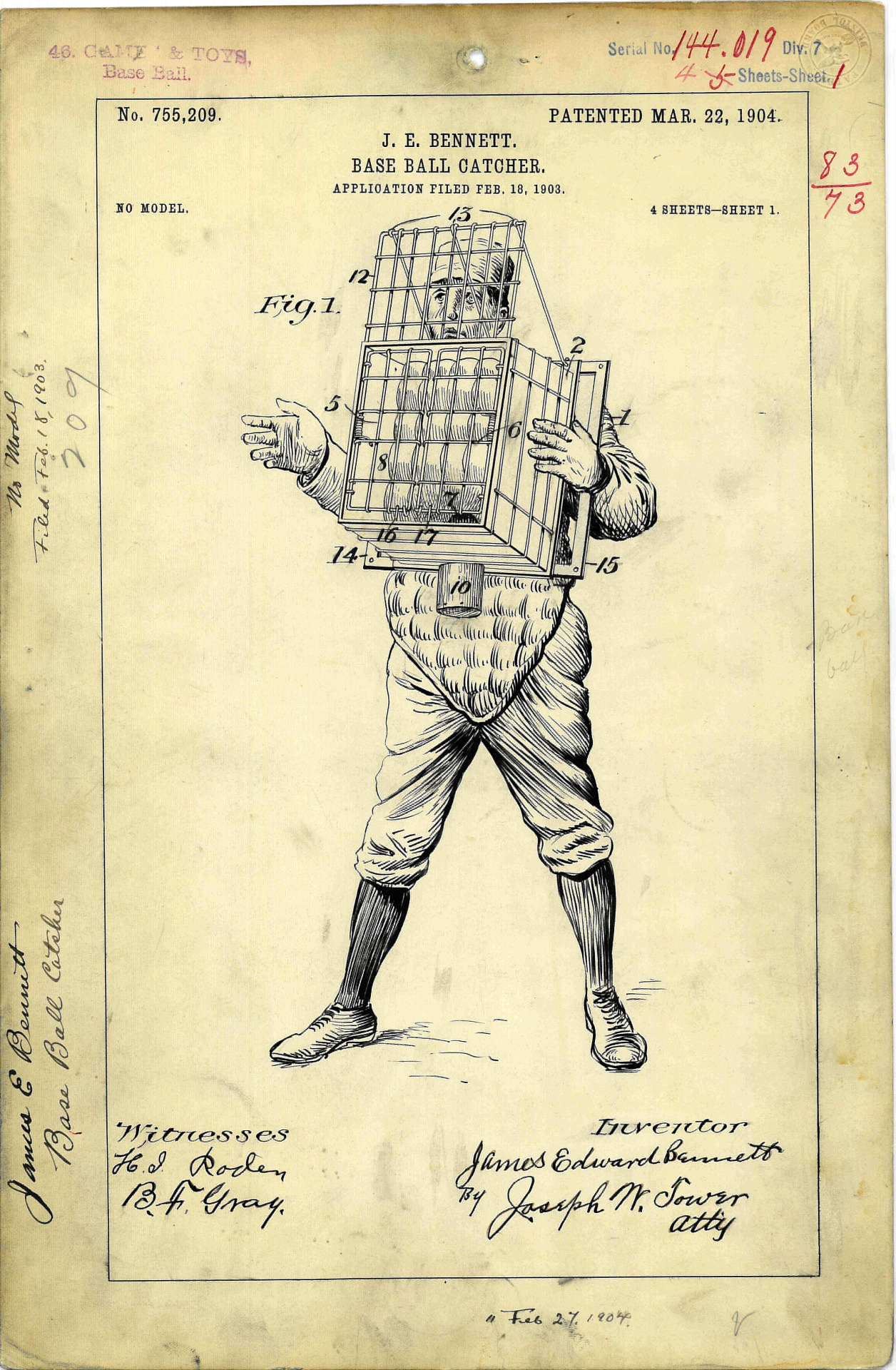
JEB Catcher Patent

As funny as it may appear and not sure if J.E. Bennett’s product was even worn, but I believe it helps identify the true purpose of the person behind the plate.

He is a Blocker first!

Velocity increased as pitchers improved their overhand technique so catching the ball was icing on the cake. OUCH!

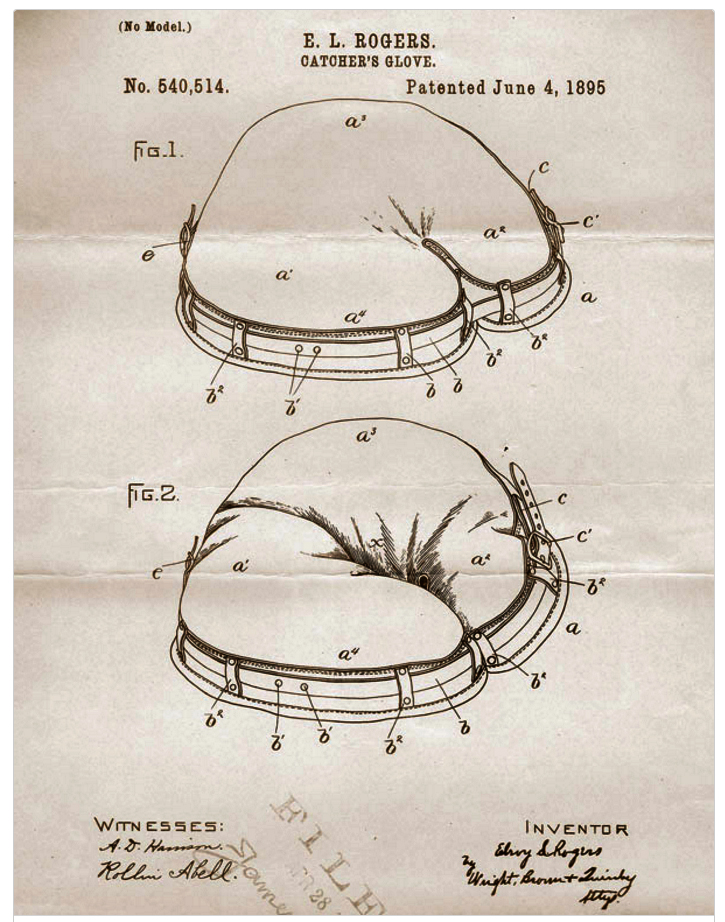
Necessity became the mother of invention [sorry Plato] with each bruised hand. According to the National Archives there were around a dozen catcher’s mitt patents issued over a 10-year span [between 1885 to 1895] while pitchers perfected their overhand approach. Again, the focus was more on deadening the ball versus catching it.

Check out E.L. Rogers patent.

EL Rogers Patent

Although no one is aware of who invented the first baseball glove, but [no pun intended] A.C. Butts filed a patent in 1883 the first fingerless glove to protect the catcher’s fingers. Unfortunately he forgot padding. So after two years of experiments with everything from sponges to led plates with shock absorbers, G.H. Rawlings patented the padded fingerless glove.

It was from here the“Tools of Ignorance” were born, a phrase coined by either Muddy Ruel [played MLB 1915-1934] or Hall of Famer Bill Dickey [played MLB 1928-1946], an ironic description of the protective equipment worn by a positional player so critical to the success of the game.

Yes, we have streamlined the J.E. Bennett’s “Base Ball Catcher” and improved the A.C. Butts and G.H. Rawlings fingerless glove, but the Catcher’s role has never changed.

However, after witnessing a college game where a catcher, dropping both knees and blocking the ball in the dirt, he chose to drop to just one knee and attempt to catch it. Resulting in the ball caroming off his lightweight fingerless glove and the winning run to score.

Wait, there’s more. I also saw a catcher who attempted to backhand a ball as if he was playing shortstop, but the word, “Olé” comes to mind.

ole


I am feeling a Plato moment coming on!

In much the same way we have improved the equipment over the years, I propose we change the name to fit the task at hand.

From now on, the position behind home plate is called, BLOCKER!

Until next Blog,

Head-Shot-for-Newsletter-Smaller

Al McCormick