“People ask me what I do in the winter when there’s no baseball. I’ll tell you what I do. I stare out the window and wait for spring.“
~Rogers Hornsby
Jay Icard’s short story, “The Game…and Nothing but the Game,” took me back to my days of playing baseball in Michigan. Mike, Frank and I loved baseball more than anything else. We too could not wait for spring, but unlike Rogers Hornsby, we built a stadium out of snow and played wiffle ball all winter long. Once the weather broke our summers were all-day affairs filled with “Right Field Automatic Out, Invisible Men, and having to bat opposite handed.” Only resting to eat the bag lunches our mother’s made.
Today it saddens me as I drive by an empty ball field, especially during the middle of the day. I truly worry the The Game is losing to X-Box and Play Station.
In much the same way Coach Crains used to say to me, “Want to have a catch?” clear your mind of everything and let Jay’s short story take you back. Back to the time where baseball “reminds us all that once was good and it could be again.” ~ Terence Mann – Field of Dreams
Enjoy –
The Game…and Nothing but the Game
By Jay Icard
For my brother Mitch and my nephews Connor and John – and all the teammates, coaches, parents, relatives, and friends that were part of the 1984 Yankees of the South Frederick Minor League.
©2010 Jay Icard.
Preface
There was a time when Baseball was just a game. It used to be America’s Game – “Baseball, Hot Dogs, Apple Pie, and Chevrolet.” I used to live and breathe it. I could not wait to see the daily paper and see how my favorite players fared in the previous day’s games. I think Major League Baseball became a business when they had a strike in 1993 and cancelled the World Series. I can assure the MLB owners and players that they lost a huge baseball fan over those events.
Beyond watching Major League Baseball, I would watch the College World Series when ESPN began to broadcast it. I, of course, collected baseball cards in the 1970s. I loved the Oakland A’s and Reggie Jackson – the A’s won three straight World Series from 1972 to 1974. When the A’s owner Charley Finely broke up the team in 1975, ultimately resulting in the trading of Reggie Jackson, I searched for another favorite player/baseball hero. Little did I know at the time, the break-up of the Oakland A’s was my first hint of baseball being a business.
In my baseball hero search, I found Mike Schmidt, a 3rd baseman for the Philadelphia Phillies. Mike Schmidt was a big-time home run hitter – the most consistent of his time – and a complete baseball player. He could hit for power, draw walks, run the bases, and was a ten time Gold Glove winner at 3rd base. He won three Most Valuable Player awards during his career, which, at the time, was a huge accomplishment as only Roy Campenella and Yogi Berra were three-time MVP winners. Mike Schmidt finished his career with 548 homeruns (he led the league eight times and is in the top 20 all-time home run hitters). He was the 1980 World Series MVP and elected to the Baseball Hall of Fame in 1995.
Most important of all in my baseball passion, I got a game called “Strat-O-Matic” baseball in 1975 when I was 10 years old. The game consisted of index cards with player stats incorporated into the probabilities of a dice roll. There were hitter cards for players and pitcher cards for pitchers. One die determined whether you looked at the hitter or pitcher cards, and the roll of the other two dice determined the number (2 through 12) that provided the outcome of the at-bat. When I was between 9 and 14 years old, if I was not outside playing my own solo baseball game (throwing up a ball and hitting it), hitting rocks with a broom handle, throwing baseball or tennis balls against the chimney of my parents house, throwing driveway stones at a tree (to practice pitching), or playing wiffle ball with my brother or friends, I was parked in our basement playing Strat-O-Matic baseball.
My first set of Strat-O-Matic baseball cards was from the 1975 season – I believe I have the majority of player statistics burned into my memory from 1975. I even remember today that an obscure pitcher named Oscar Zamora from the Chicago Cubs allowed 17 home runs in 71 innings in 1975. Oscar Zamora’s 1975 and Mike Schmidt’s 1986 MVP season Strat-O-Matic cards are shown below. I got additional sets of Strat-O-Matic cards in 1977, 1980, 1983, and 1986.
Strat-o-Matic Cards

This was what kids did before computer games – played games with cards and dice. I had my own teams and league and kept statistics on sheets of paper with tally marks. I used scoring sheets for my “World Series,” which is how I learned to keep score and hence started keeping score for the “Yankees” – the team in this story. Later in the story there are actual scanned pages from the Yankees 1984 official scorebook.
This is a story about the game of baseball, when it was a game and one great baseball game. The game in this story was played 25 years ago in July 1984.
The South Frederick Minor League
When I was nine years old, growing up in Frederick, Maryland, the thing to do was play baseball. There were three Little Leagues in Frederick at the time: East Frederick, National, and American. Each league had four teams. Back then, you had to go and “try-out” for Little League, which consisted of a grown man firing pitches at you with 50 kids in the field. If you were not able to distinguish yourself in the tryout, you had to “know” someone to get on a team. Needless to say, I did not get on a Little League team when I was nine. We got a call after the tryouts from someone involved in a “Minor League” for kids that did not make the Little League. I declined. As I spoke with several friends at East Frederick Elementary school over the next year, I found out more about this Minor League. It turned out that I had several friends in the “South Frederick Minor League” (SFML). I was involved in the South Frederick Minor League in Frederick in the late 1970s and early 1980s.
The SFML has six teams: Yankees, Orioles, Angels, Dodgers, Mets, and Pirates. The League was set up such that each team played the other two times: once in the “first half” and once in the “second half.” The team with the best record from each half would play for the Championship. If a team went 10-0, they were the automatic champion. The SMFL had rules that every player must play in every game for at least two innings in the field, every player must have at least one time at bat, and no pitcher could be over 11 years old as of May 1st of that year.
The SMFL home was at Manassas J. Grove Park on the corner of Franklin and South Streets, about a block from the Frederick Fair Grounds. When I played, the field was an all-dirt infield with a wooden slat snow fence and a scoreboard with metal numbers that someone volunteered to place during the game. The majority of the players came from East Frederick and South Frederick Elementary schools. Most of the kids were from blue collar families who lived in and on the outskirts of the east side of Frederick. Many of the kids came from a housing project near the Fairgrounds called “Sagner.” I did not know what a housing project was back then – I just knew a lot of African-American kids lived there.
The Yankees
I joined the SFML via the Yankees in 1975. Prior to my joining the Yankees, they had gone two straight years without a win. I played outfield in 1975; we went 3-7. I pitched and played 3rd base in 1976; we went 4-6. I played 1st base in 1977; we went 4-6. We were a mediocre team. The Dodgers, Angels, and Orioles typically had strong teams, and I remember getting completely routed in a few games. This was a time before the mercy rules went into effect. I remember a particular game against the Dodgers where they scored 29 runs in the 4th inning…I believe the final score was 62-6 or something like that. I played for Dave Cline and Rusty Schoendig as managers in 1975-1977.
After my playing “career” was over, I graduated to being a team coach and scorekeeper for the Yankees – the team manager at the time was a guy named Bob Smith. Bob did a good job of teaching players the game fundamentals and establishing some drills that I would use when I eventually became the manager. In 1979, under Bob’s leadership as the manager, the Yankees finally developed into a strong team. We went 5-0 and won the first half, but we lost to the Pirates and another game in the second half finishing 8-2. We played the Pirates in the Championship in 1979. Nothing went right for us in that game, and we lost. Bob resigned as manager and turned the team over to another manager (Bob Vaughn). Just to be clear, there were plenty of politics, agitation, and childishness from the parents and adults in this league, and it would wear on the managers and coaches.
In 1980, Bob Vaughan took over as manager and kept me on as a coach and scorekeeper. Since I had been coaching for two years and played for the three years prior, Bob let me pick the players at the “draft” and essentially run the practices using many of the drills that Bob Smith had put in place. In 1980, my brother Mitch was eight years old and could join the team. Mitch pointed out a friend at the draft – a little guy named Arthur “Boo” Tyeryar, who I picked later in the draft. For some reason in 1980, our enrollment in the SFML was very high, and we had over 20 players on the team – it was a nightmare getting them all in the game and getting them all one time at bat. We went 3-7 in 1980 and struggled through the season.
At the end of 1980, we developed our first SFML All-Star squad coached by Amos Brown. Anyone who lived in Frederick in the 1970s knew Amos Brown. He was a cool dude and an exceptional athlete. He dedicated a lot of his time officiating and refereeing kids’ sports. Amos had a younger brother, Timmy, who played on high school football and basketball teams with me and who was also an excellent athlete. Amos brought me on to assist him and be the scorekeeper for the SMFL All-Star team. I learned additional coaching techniques and drills from Amos. Our All-Star team played the North Frederick Minor League and a few other county teams. Our team won every game in All Star play. I began to recognize the talent that was hiding in our league.
Bob Vaughan turned the manager duties over to Earl Matlock in 1981. Earl had coached with me in 1980, and neither of us were satisfied with the results. Earl brought on two other coaches: Bob Houseman (a former professional baseball player who played in the Pittsburgh Pirates farm system) and Marvin Harrison. In 1981, we got more tips from Boo and Mitch at the draft and selected Tommy Tyeryar (Boo’s cousin), Robbie Bitler, and Jamie Miller (both friends of Tommy’s). Tommy, Robbie, and Jamie came from over on 3rd Street in Frederick. If you drove down 3rd Street and stopped at the light on 3rd and Bentz Street in the 1970s/1980s, there was a good chance you would see those boys playing baseball in the park on 3rd and Bentz. We also picked a former player’s (Darnell Randolph) brother named Porky Randolph. Earl, Bob, Marvin, and I worked with the kids and continued to hone and improve our drills. In 1981, we finished 6-4. At this time, the Mets had a dominating team winning back to back Championships in 1980 and 1981.
In 1982, we continued to add players, and Boo Tyeryar had developed into a dominating left-handed pitcher at 10 years old. Our players had grown into a strong core, and Mitch, Porky, Tommy Tyeryar, Robbie Bitler, and others continued to develop as players. In 1982, we won the first half finishing 5-0 and were 4-0 into the second half. We had a showdown with the Dodgers on the last game of the season. If we won, we would be the Champions. If we lost, we would have to play them again. For some reason, Boo had an off night pitching, there were a bazaar series of outbursts between some coaches and the parents, and we ended up losing the game. We came back in a few days and defeated the Dodgers to win our first league Championship. Earl turned the manager duties over to Marvin Harrison for 1983.
In 1983, we came in with a strong and dominating team. Boo Tyeryar was overpowering as a pitcher to the point where we shifted the entire outfield because no hitter could get around on his pitches. The Yankees finished 10-0 in 1983 and never had a close game.
During the years leading up to the 1984 season, a lot of the players lived and breathed baseball. For those of us that did not live near a park, our game was backyard wiffle ball. Anyone who ever played the game knows there is no more intense competition than a game of backyard wiffle ball. I taught Mitch to hit through wiffle ball primarily. I can assure anyone that when we played, I never gave him a softball pitch. He learned at a very young age to hit fastballs, curve balls, sliders, sinkers, risers, and change-ups. If we did not have baseball practice or a game, we were in our backyard frequently joined by Boo Tyeryar playing wiffle ball. I believe that the hand-eye coordination that Mitch gained through the thousands of hours of wiffle ball developed him into one of the best contact-hitters and strike-zone eyes in our league.
The Players in 1984
In 1984, Boo had to graduate to the Babe Ruth level league, and we did not have many experienced pitchers. We added Eric and Anthony Cartnail, whose uncle Tim played for the Dodgers when I played. Eric and Anthony both pitched and played outfield. Tracy Diggs was our most experienced pitcher. We also added DJ Gregory to play 3rd base. Mitch played center field. Porky played catcher – the most important position for this level of baseball. Robbie Bilter played 1st base – a position he always wanted to play. Tommy Tyeryar played shortstop, and Jamie Miller played 2nd base with some very soft hands. We also had Tommy’s little bother, Billy, who played outfield and was a pretty good hitter. Tracy Diggs played outfield as well, along with a couple of young guys: Carl Fischer and David Willard. The 1984 Yankees team picture is shown on the next page. The tall, handsome guy in the on the left in the back row is me!
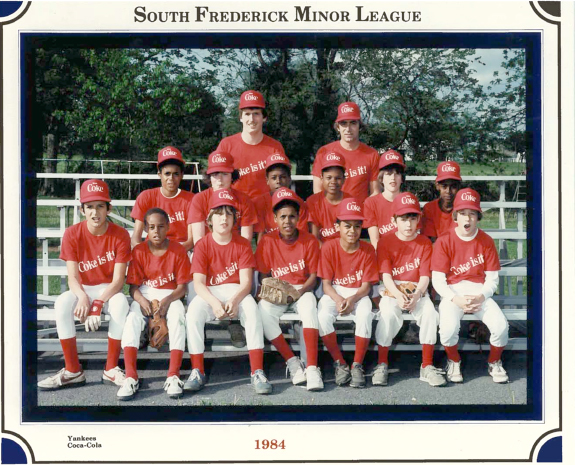
Left to Right
Bottom Row: Mitch Icard, Anthony Cartnail, Billy Tyeryar, Tracy Diggs, Carl Fischer, David Willard, Jamie Miller;
Middle Row: Kevin Franklin, Robbie Bitler, Porky Randolph, D. J. Gregory, Tommy Tyeryar, Eric Cartnail;
Back Row: Jay Icard, Marvin Harrison
The 1984 team was very strong as most of the core players had been on the team for four or five years. They knew the drills, they knew what to do in most situations, and they played smart baseball. We played sound defense and were very strong “up the middle” anchored by Porky at catcher, Tommy and Jamie at short and 2nd base, and Mitch in centerfield. The up the middle strength was similar to the teams in the Major League developed by Sparky Anderson, like the Cincinnati Reds of the 1970s and the 1984 Detroit Tigers. They had all played and practiced together for three to five years and played great fundamental baseball. We were an offensive powerhouse. We scored 245 runs in 12 games. We batted .482 with over 50% of our 187 hits going for extra bases and drew 119 walks. Mitch led the team with a .697 batting average, followed closely by Porky with a .642 average. We had five players with on-base-percentage over .600: Mitch .796, Bitler .679 (led the team in walks with 16), Porky .667, DJ . 639, and Tommy at .603. Porky led the team in hits and RBIs…he wanted nothing to do with talking a walk. The only area we had that was not dominating was pitching. The statistics from the Yankees 1984 official scorebook are provided in the figure below.
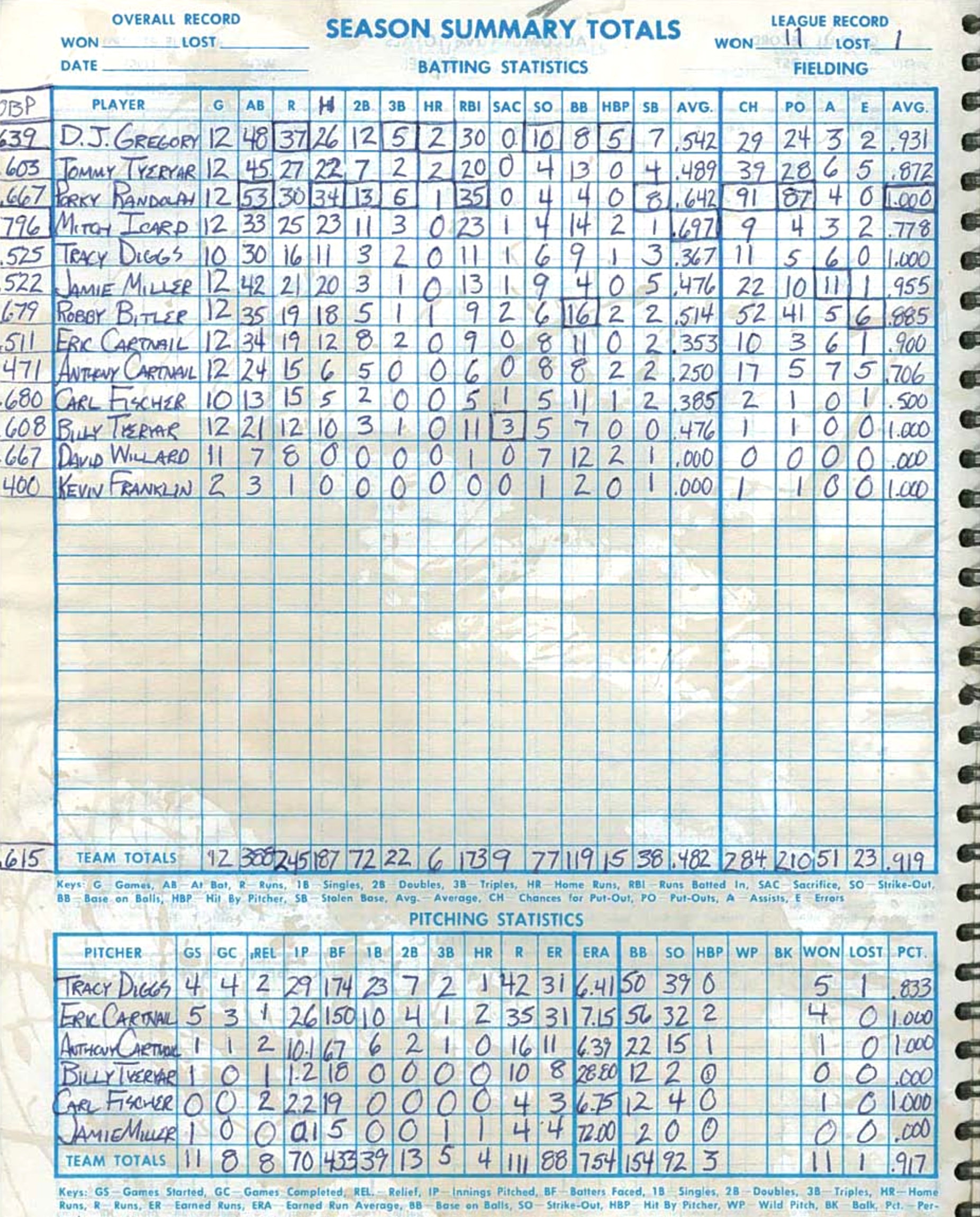
1984 Yankees Season Statistics from the Official Scorebook
The 1984 Season
We started the 1984 season strong, winning three straight games. In our fourth game, we faced the Mets, who had developed two strong pitchers: Anthony and a girl who also went by the nickname “Porky”. Anthony and Porky threw the best fastballs in the league. In the first inning, three of our batters were hit by pitches and many were brushed back. The hit by pitches got into everyone’s head, and we did not bat well. The Mets ended up scoring the game-winning run in the bottom of the 6th and beat us 15-14. I was furious about losing the game – I knew we had a better team, the Mets just had better pitching. It was the first loss for the Yankees in 2 years.
The next practice after our loss to the Mets, I told the team it was a fluke. It was funny looking at the kids who had been on the team for a few years – they were furious about the loss too. I counseled them about letting hit by pitches affect their game. I changed our batting practice where I pitched to them. I was almost 20 years old and would gun the pitches at batting practice so that they would not be afraid of a fastball. We won the next seven games, including completely dominating the Mets in our rematch (our Porky had an inside-the-park grand slam home run). We ended up playing 11 regular season games in 1984 because we had to replay a game with the Angels due to a issue with a players birth certificate…I still count the 11th game in our record and stats as a form of protest. The dates, opponents and game scores are show below. With our season finished, we had won the second half of the season, and the Mets had won the first half. There would be one final game for the SFML championship…this is the game.
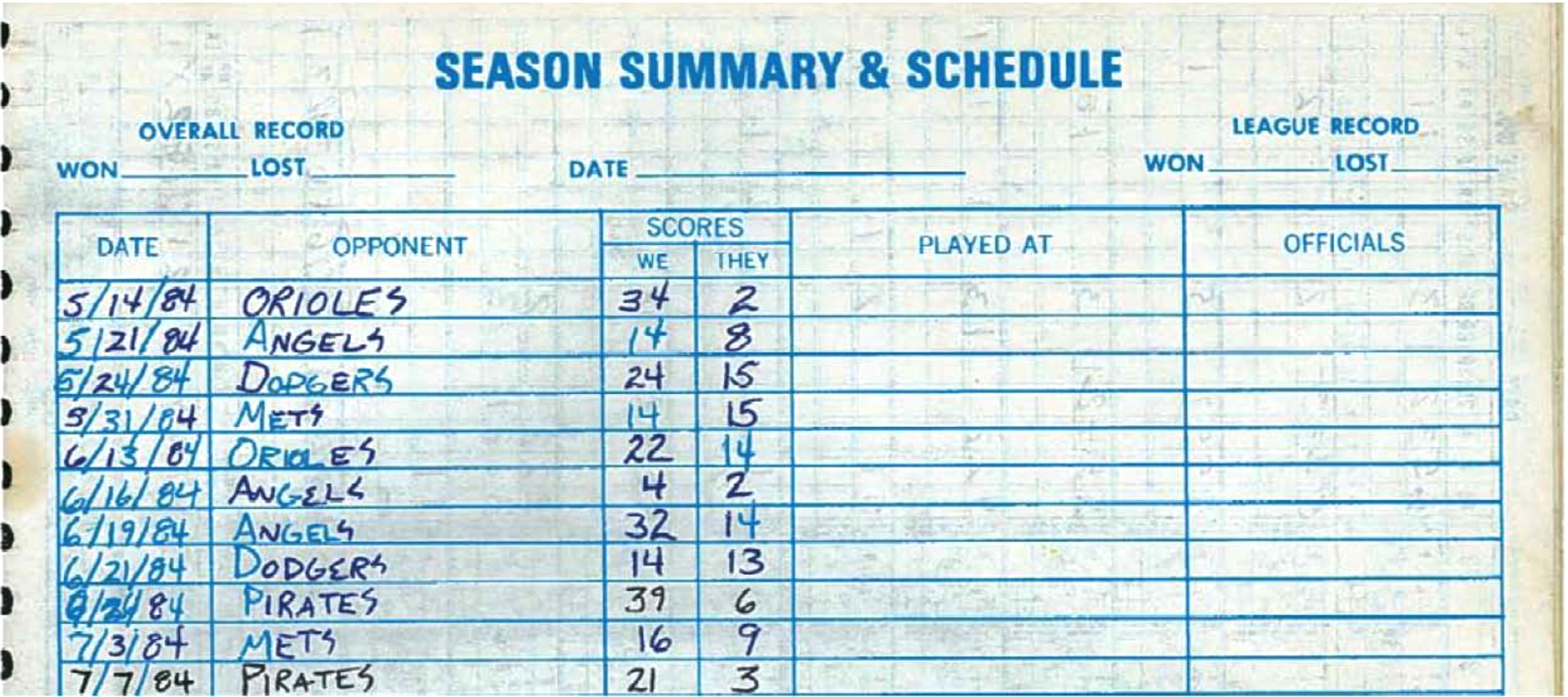
1984 SMFL Yankees Season Games
The Game
It was a perfect summer evening on July 10, 1984. The 10-1 Yankees would face the 8-2 Mets for the 1984 SFML championship. We drew the visiting team in the game, and we were fine with it…we liked to bat first. Our lineup and batter order was:
DJ – 3rd Base
David Willard – Right Field
Tommy Tyeryar – Shortstop
Porky – Catcher
Jamie – 2nd Base
Bitler – 1st Base
Eric – Pitcher
Mitch – Centerfield
Carl – Left Field
Porky (the girl) started the game at pitcher for the Mets. The Yankees were not afraid of her anymore – we started the game with four runs in the 1st inning, highlighted by a run scoring single by Porky and a two-run double by Eric. The Mets scored three runs in the bottom of the 1st as Eric had some trouble finding the strike zone. He walked four of the first six batters – three of them after a 3-2 count. I pulled Eric with only one out and the runners on 2nd and 3rd and replaced him with Anthony. Anthony walked the first batter and then struck out the next two.
We had three flyouts in the top of the 2nd (we were hitting the ball – but right to the Mets). In the bottom half of the 2nd, Jamie Miller made an excellent play at 2nd base and turned a double play.
In the top of the 3rd inning, Mitch and Billy drove in runs to give us a 6- 3 lead. In the bottom of the 3rd, we started out by allowing a runner to reach on an error and two walks to load the bases. The Mets followed with a two-run single and scoring a run on a fielder’s choice to tie the game. Mitch made a great play in the field, throwing out a runner at 2nd base, but we gave up another run, and the Mets had the lead 7-6.
In the top of the 4th inning, the Mets’ pitcher Porky began to struggle as she allowed Tommy a double and our Porky a single and had some control problems. They replaced her with Anthony and with the bases loaded. Bitler, Billy, and Mitch drew consecutive walks, allowing Tommy and Porky to score and put the Yankees back in the lead 8-7. In the bottom of the 4th, we held the Mets scoreless as our Porky caught a pop-up and Bitler made an excellent play catching a line drive at 1st base.
In the top of the 5th inning, DJ flew out to centerfield, and Tommy hit a line drive that was caught by the Mets shortstop – again we were hitting the ball, but right to the Mets. In the bottom of the 5th, the first three Mets got on base with two hits and a fielder’s error (Bitler got a bad bounce on a ground ball). Anthony walked the next batter to tie the game. I walked out to pull Anthony, and he had tears in his eyes. He was a small kid who was tough as nails and very competitive. I put Tracy in to pitch, moved Billy to right field, and brought Eric back in the game to play left field. Tears streamed down Anthony’s cheeks as we walked back to the dugout. I kept telling him he did a great job, but I am sure he felt like he let the team down. Tracy allowed two more runs but got us out of the inning. Unfortunately the Mets now had a 10-8 lead, and we had one more inning to close the gap.
In the top of the 6th, Porky led off with a fly ball to center on the first pitch but again hit right to the Met centerfielder, and we had one out. Jamie was the next batter, and he struck out on three pitches – he had fallen into an end-of-year batting slump, and his swing timing was slightly off. Now we had two outs. Bitler was heading up to the plate. I remember Porky looking at me with concern. We had come a long way together. He was our team leader and an old soul for a 12 year old. This was it for us.
Bitler took the first pitch as a ball. The next pitch was a strike. I called timeout. I gave Bitler just a quick bit of encouragement to let him know to make Anthony throw him a strike. The next two pitches were balls and the count was 3-1. Anthony threw a strike, and now the count was 3-2 and our season was down to the next pitch. I called timeout again. Same thing again, I told Bitler to make him throw a strike. I remember this moment like yesterday as I walked back to the 3rd base coach’s box (I coached the base near our team’s dugout, and Darnell Randolph coached the other base): the Mets 3rd basemen said to our team in the Yankees dugout that the Mets were going to Pizza Hut after the game.
Now this was really it! Everything came down to this pitch…3 Balls, 2 Strikes, and 2 Outs, and the Yankees were losing by two runs. The Mets pitcher, Anthony, wound up and threw the pitch. Bitler had to jump back in the batter’s box with both arms in the air. The pitch was inside, and he had drawn a walk – we were still alive. Whew!
Billy came up to bat next. He was still a young player, but he could hit. After a swinging strike, Billy singled to right field, and now we had two runners, including the game tying run on base.
Mitch came up to bat. This is every kid’s dream. Two outs, men on base, your team is behind, and everyone is counting on you to come through. I was now living it through my little brother. After thousands of baseball and wiffle ball pitches from me, I can assure you there was no pitcher that could intimidate Mitch.
Here we go again. Our season is on the line. I believe at this time, my Mom hid her eyes in the stands. Anthony reared back and threw, “Ball one”, again “Strike one”. With a 1-1 count, Anthony fired another pitch…time seemed to stand still… and after a frozen moment, Mitch crushed the third pitch into left-center field. The stands erupted with cheers, every Yankee was jumping up and down in the dugout as Bitler and Billy rounded third and scored the game tying runs. Mitch wound up on 2nd base with a two-run double, and the game was tied at 10-10! WOW!!! We had tied the game!
Eric was the next batter, and he hit a fly ball to the Mets left fielder for our third out.
In the bottom of the 6th, Tracy was throwing heat. After the first batter got a base hit, he struck out one, walked one, and struck out the last two. The score remained tied 10-10, and the game would have to go into extra innings.
In the top of the 7th, we started batting with the top of our line-up. The whole team was full of confidence. DJ popped the first pitch up to the Mets shortstop to give us one out. Tracy drew a walk, and Tommy got on base through a throwing error by the Mets second baseman. Tracy sped to 3rd base and Tommy to 2nd on the error. With one out and runners on 2nd and 3rd base, Porky came to bat and probably his last at-bat as a Yankee. Porky swung and missed the first pitch, “Strike one”; the second pitch again swing and miss, “Strike two”.
Porky had walked only four times during the season and was not about to take a walk now. Porky stroked the third pitch into right center field, and the crowd and Yankee bench erupted again. Tracy and Tommy scored as the Yankees took a 12-10 lead. I remember seeing the big smile on Porky’s face as he stood on base, and what a contrast to his look of concern back in the previous inning when were down to our last at-bat.
Jamie struck out for our second out. Bitler drew another walk. With two outs and Porky and Bitler on base, Billy hit a grounder to the same 3rd basemen who was talking about Pizza Hut. The ground ball went through his legs into left field, and Porky scored to give the Yankees a 13-10 lead. Billy got to 2nd base, while Bitler stopped at 3rd. Mitch came to the plate again with two outs and runners in scoring position. With two balls and one strike, the fourth pitch hit Mitch in the wrist, and he started down the first base line. The field umpire overruled the plate umpire and called it a foul. I argued the call with the field ump, who had made several calls during the game and season against the Yankees. I even showed him the red mark on Mitch’s wrist to no avail. Mitch came back to the plate and popped the next pitch up back to the Mets’ pitcher, Anthony. We would go to the bottom of the 7th with a 13-10 lead. We were very confident that we could shut them down, but I felt like the field ump’s bad call would come back to haunt us.
In the bottom of the 7th, the Yankees took the field with confidence. We had a three-run lead, and our best pitcher (Tracy) on the mound. Tracy worked the first Mets batter to a 2-2 count. He hit the 5th pitch between Bitler and Jamie for a base hit. With a runner on first and no outs, Tracy got ahead of the next Mets batter with 1 ball -2 strike count. Tracy had struck him out on his previous at-bat. After the 2nd strike, Tracy “moonwalked” back to the mound (Michael Jackson’s moonwalk had infected all the kids back in 1984). The batter connected with Tracy’s 4th pitch, a line drive into left field. Eric charged the ball and made a sliding catch on his knees for the first out. The crowd erupted again. Tracy proceeded to strike out the next batter on four pitches.
Now there were two outs. We were one out away from our third straight Championship. The next batter worked the count to 3 balls and 2 strikes. Tracy threw the next pitch, and the batter nailed a line drive into right field…time seemed to freeze again…I remember seeing Billy charge the ball. He slid on his knees and made a great catch! That was it – we won! The team rushed the field; I dropped the score book and never drew in the direction of the hit. We all hugged each other, and the crowd “went wild”! The score sheets from the 1984 Yankees official scorebook are shown on the following pages. I never get tired of going back and looking at them.
After the game was over, I had almost every parent come up to thank me. Lots of people that had been around the SFML since I was a kid came up and told me what a great game it was…I certainly agree. There was an old African-American fellow who walked with a cane and had hung around the ballpark ever since I was a kid. Occasionally, he would umpire a scrimmage if needed. He pulled me aside and told me how smart I was for calling the timeouts when Bitler was up at bat with 2 outs. He told me I threw the pitchers’ rhythm off – I never thought about it when I was doing it. I took it as a compliment.
We left the ballpark and made our usual stop for a Brown’s pizza. We had all-star games similar to years past within and with other teams. My family had a party for the Yankees at our house out in northern Frederick County. We made pizzas and played wiffle ball. I had my Mom’s car full of eight kids when I took them all home.
Over the years, I have seen a few of the players from the Yankees. I am sure none of the members of that team will ever forget that season or that great game in July of 1984. It is one of my fondest memories.
The season and that particular game was the epitome of a team effort and a demonstration of years of practice from the majority of the kids. I could not be prouder as a coach or a big brother when I look back on that game. Hopefully, someday in the future, baseball will return to a game so that other kids like me and the Yankees players of the SFML can have a memory like this one.
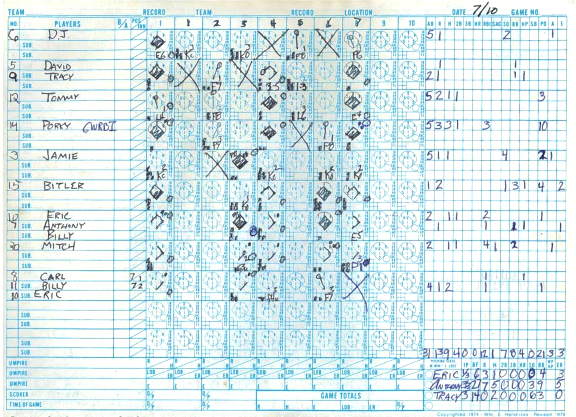
1984 SMFL Championship Game Scoresheet ‐ Yankees
1984 SMFL Championship Game Scoresheet ‐ Mets
Thank you Jay for letting us use your memory to remind us of ours!
Until next BLOG,

Al McCormick